

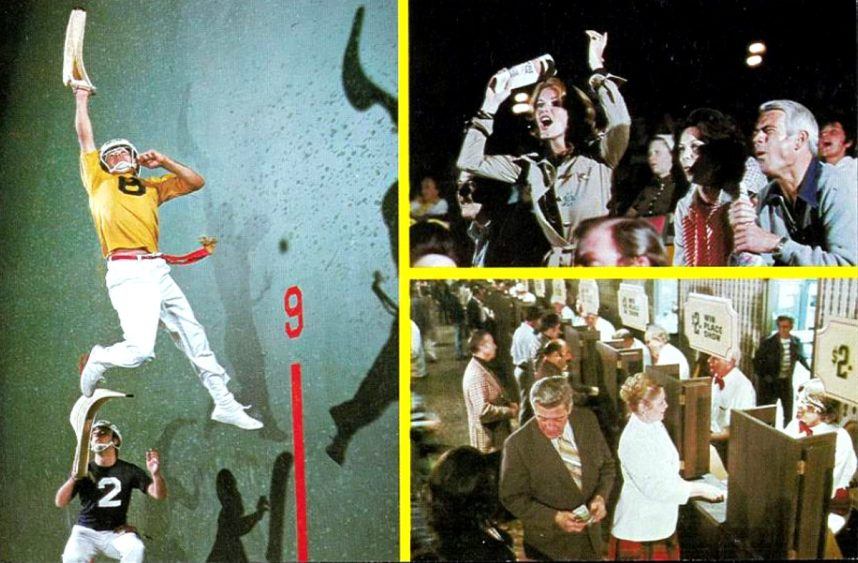
When Kirk Kerkorian opened the original MGM Grand Hotel (today’s Horseshoe Las Vegas) on December 5, 1973, he wanted more than slot machines and showrooms. He wanted spectacle. So inside what was then the largest resort in the world, he built a 2,200‑seat jai alai fronton — the only one ever to grace the Las Vegas Strip. The games began three weeks later.
Balls to the Wall
The sport, imported from Spain’s Basque country, was billed as “ballet with bullets.” Players hurled a goat‑skinned pelota at speeds topping 170 miles per hour using curved wicker baskets called cestas. Pari‑mutuel betting was allowed, just like horse racing.
Director Harry “Coon” Rosen — whose nickname derived from his jet-black raccoon hair — was brought in from Tijuana to lure gamblers with a new exotic thrill.
For a while, it looked like a hit. Celebrities James Garner, Michael Landon, and Pete Rose were spotted in the stands. The fronton even appeared in Hollywood: Jon Voight and Ann‑Margret filmed scenes for “Lookin’ to Get Out” there in 1980, with a five-year-old Angelina Jolie making her screen debut in the audience.
Dropping the Ball

The glamour masked a mess. Players — mostly Basques, Spaniards, and Mexicans — scraped by on meager pay, with the Tijuana contingent earning a reported $126 a month after brutal currency conversions. Fights broke out in locker rooms.
Everything came to a boil In October 1975. That’s when the full roster of 32 players walked out, demanding union recognition and better wages. MGM warned that their work visas would be revoked if they didn’t return. Immigration officials backed the threat.
The strike reportedly ended with a slew of deportations in November 1975, and MGM restarted with a new roster in late December, after the old players’ contracts had expired anyway.
That new roster included Kenny Pyle. Plucked from Miami’s jai alai school, he played thousands of matches over seven seasons and became the standout American player — though what he remembered most was being resented by his foreign teammates. Bad feelings from the busted strike left scars.
Meantime, the crowds had begun to wane. Admission fees were always steeper than for other frontons and there were no matinee shows for the families. Also, Rosen refused to allow trifecta betting — a Florida staple that juiced wagering.
Nightly handles hovered around $50,000, respectable but nowhere near Miami’s $350,000 highs.
Bye, Alai
The 1980 MGM Grand fire, which killed 87 people, disrupted operations but did not directly end jai alai. The fronton reopened months later, yet the waning interest intensified. By November 1983, it proved to be one loss-leader too many for MGM, which shut it down.
For Las Vegas, jai alai was a bold experiment that never found its audience. It was exotic, fast, and dangerous, but too unfamiliar, too poorly managed, and too overshadowed by the Strip’s endless cavalcade of sexier entertainment.
“Lost Vegas” is an occasional Casino.org series spotlighting Las Vegas’ forgotten history. Click here to read other entries in the series. Think you know a good Vegas story lost to history? Email [email protected].
The post LOST VEGAS: Jai Alai on the Strip appeared first on Casino.org.





