

It seems absurd to build a monorail in America’s second-largest tourist hub that stops short of the airport. But Las Vegas did exactly that more than two decades ago — and ever since, most tourists and locals have blamed the lowest-hanging fruit: the taxi and limousine lobby.
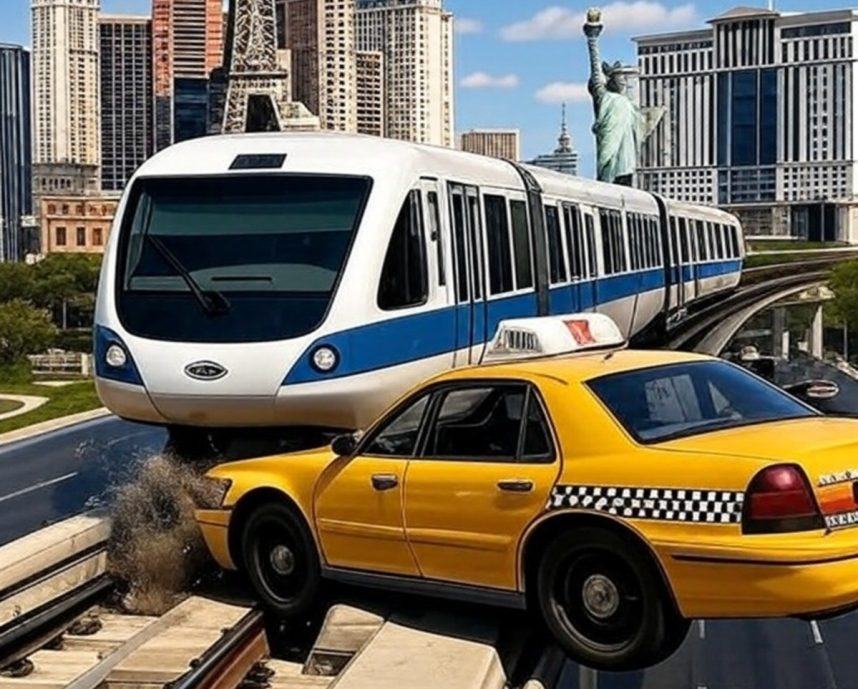
According to the popular story, greedy cab and limo companies prevented the monorail from reaching the airport to protect their cash cow: overpriced rides from baggage claim to the Strip. But that’s not what really happened.
Mono Log
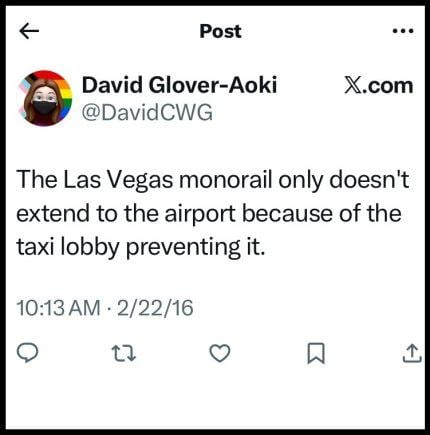 The first vision for a monorail in Las Vegas was a public-sector initiative to connect the airport to downtown via the Strip. Led by Clark County and the Regional Transportation Commission of Southern Nevada in the 1990s and early 2000s, it was to be a comprehensive transit spine for tourists and workers.
The plan progressed through multiple feasibility studies and route proposals from the 1970s to the early 2000s, but stalled due to its high estimated cost (up to $1 billion), lack of federal support, and jurisdictional fragmentation.
The system that actually got built in 2004, the Las Vegas Monorail, was a privately financed project with a much narrower scope. It focused only on moving tourists between casinos and the Las Vegas Convention Center. Though the casinos themselves didn’t fund its $650 million cost, its business model depended on fare revenue from tourists, and the Strip’s casino corridor was the densest, most potentially profitable source of foot traffic.
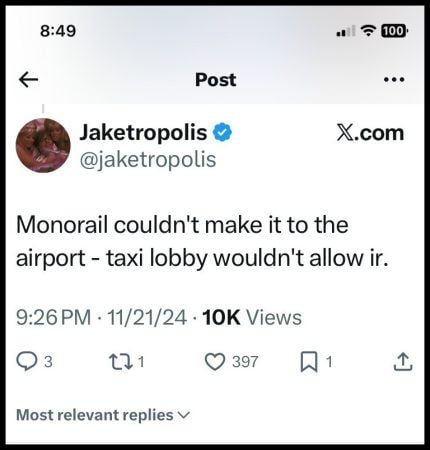 An airport spur was always intended as a future phase, however. And the first proposal for one was floated in 2005, only a year after the monorail opened.
Objections were raised in public forums by the Nevada Taxicab Authority, which regulates the taxi industry, and the Limousine Operators Association of Nevada. Both are well-connected entities with a track record of influence — evident in their successful crushing of pedicabs and the strict regulations Clark County imposed on Uber and Lyft when they entered the Las Vegas market in 2015.
But there’s no evidence that their opposition to an airport extension was decisive — or even necessary.
What Really Happened
Federal transit officials had already disapproved of the extension, and their financial support was essential for the project to afford its $400 million price tag.
Those officials cited weak ridership projections and financial instability. And they weren’t wrong on that second point: the Las Vegas Monorail filed for bankruptcy in 2010 and again in 2020, after which the Las Vegas Convention and Visitors Authority bought it for the fire-sale price of $24.3 million (26.7% of its original cost).
Clark County Aviation Department officials also objected, noting that the monorail’s Disneyland-style cars lacked luggage racks and were thus nearly useless for airport service. This was another good point.
The airport extension proposal was revived in 2006 (at an estimated cost of $450 million) and again in 2008 ($500 million). And taxi and limo representatives again voiced their opposition.
But the plan’s forward progress continued to be thwarted by one thing only: a chronic lack of funding.
“The taxi mafia did it!” makes for a better story. But this proposal died from financial starvation, not assassination.
Look for “Vegas Myths Busted” every Monday on Casino.org. Visit VegasMythsBusted.com to read previously busted Vegas myths. Got a suggestion for a Vegas myth that needs busting? Email [email protected].
The post VEGAS MYTHS BUSTED: Taxi Lobby Stopped Monorail from Reaching Airport appeared first on Casino.org.





